


Business | System Integration (SI)
System Integration (SI)
From IT assets to operations,
a new standard for optimized services
Based on years of experience and know-how, Whynet runs diverse information systems effectively,
driving continuous improvement through integration, linkage, updates, and cost efficiency.
IT Assessment & Consulting
With public-sector and large-scale network build experience,
we assess IT systems and propose optimal improvements.
From legacy analysis to ops guidance, we deliver cost-efficient consulting.
AI Adoption Consulting
We apply AI to network and security operations to improve efficiency.
Using proven solutions like Mist AI and MAVIS, we support monitoring.
We also provide automation and tailored AI adoption consulting.
Information System Operations & Maintenance
Based on NI/SM operations experience, we integrate management.
With processes based on ISO/IEC 20000, we ensure uninterrupted operations,
preventive checks, rapid response, and continuous system improvement.
Infrastructure Operations & Improvement
With public-sector and data center build experience, we connect on-prem and
cloud flexibly. Across IDC migration, build, and operations, we ensure stability
and compatibility, supporting future-oriented optimization.
Security Assessment, Operations & Improvement
To block threats in advance, we provide vulnerability assessment and
security monitoring. With ISO/IEC 27001, we run cloud-based security and
privacy protection to build tailored security environments.
Dev Environment Build & Operations Support
We build and operate modern DevOps and CI/CD environments.
By optimizing dev environments with network and security, we boost output
and support stable systems aligned with customer needs.
Custom IT consulting
with experts across domains
With Whynet's methodology, we support large-scale information system operations
by presenting new, optimized solutions.
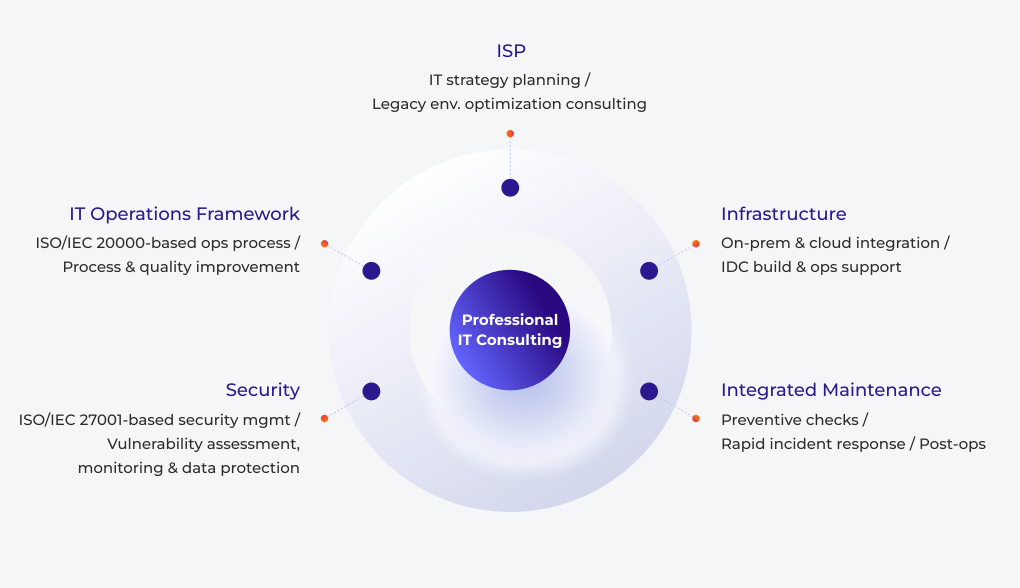

Fast, flexible scaling
through tailored IT services
Using vast legacy data and Whynet's processes, we strengthen operational efficiency
and maximize business value.

Professional consulting at minimal cost
• IT status/env diagnosis > issue analysis > improvements
• Tailored design/build consulting by use and budget
• Easier IT level assessment and data accumulation via KPIs
01

Analysis Targets
• Servers, storage, DB, network, security
• Architecture, traffic flow, vulnerabilities
• Security factors based on KISA and NIRS checklists
02

Key Deliverables
• IT current-state analysis report
• Architecture design document
• Informatization strategy report
03
Key Activities
Low-cost execution
Direction analysis
Goal definition
Execution plan
Key Activities
• Collect/review current data
• Select target items
• Conduct stakeholder interviews
• Organize requirements
• Review laws, regulations, and guidelines
• Analyze technology trends
• Summarize current-state analysis results
• Feasibility analysis
• Risk analysis
• Target selection
• Define execution strategy
• Future value analysis
• Architecture design
• Define implementation tasks
• Define implementation roadmap
• Cost-effectiveness analysis
• Phase-by-phase strategy
• Execution organization and schedule
• Benefits analysis
• Activation and rollout plan
Consulting Process
Consulting Methodology Framework
Project kickoff and
participant selection
Information system
direction setting
Business and IT
requirements analysis
IS structure and
requirements definition
IS build project
implementation plan
Form executive support organization
Review informatization strategy
Business and IT current-state analysis
Define IS architecture
IS build
project plan
Set up project execution organization
Benchmarking analysis (Optional)
Business requirements analysis
Inter-requirement dependency analysis
Evaluate split-contract feasibility
Project planning
Define IS scope
and direction
IT requirements analysis
Draft IS requirements
specification
IS budget planning
Review IS scope and direction
Review business and IT requirements
Review IS requirements specification
Draft RFP
IS build
Vendor selection support
| Task Area | Details | |
|---|---|---|
| Phase | Activity | |
| Environment Analysis | Management Environment Analysis | Analyze external factors and management strategy to derive implications for responding to change drivers. |
| Law/Regulation Analysis | Analyze relevant laws and systems to derive requirements that may affect the project and reflect them in target model design. | |
| IT Environment Analysis | Review technology trends and changes to analyze applicability and use cases. | |
|
Current-State Analysis
(As-Is Analysis) |
Business Status Analysis |
Analyze organizational roles and workflows, then create process maps and activity definitions
to identify issues and improvement needs in the current organization and workflow system. |
| IT Current-State Analysis |
• (Business systems) Diagnose current systems to derive issues and improvement needs
• (Data) Diagnose current data to derive issues and improvement needs • (Infrastructure) Diagnose hardware, software, network, storage, etc. to derive issues and improvement needs • (IT governance) Diagnose IT work/processes to derive issues and improvement needs |
|
| Benchmarking | Select benchmarking targets based on issues from current analysis (business & IT), then research and analyze best practices. | |
| Gap Analysis | Derive requirements from best practices, then analyze gaps with existing informatization requirements to set improvement direction. | |
|
Issue integration and
improvement tasks |
• Group related issues derived from current analysis (issues and improvement needs)
• Analyze root causes and derive improvement tasks (apply insights from best-practice research) |
|
| Informatization Vision & Strategy |
Link environment and current-state analysis to set vision, goals, phased execution strategies, and IS build principles
and define technology requirements and information management strategies for IS. |
|
|
Target Model Design
(To-Be Model) |
Detail improvement tasks | Detail improvement tasks derived from current analysis (overview, scope, To-Be direction, use cases, etc.). |
| Business Process Design |
• Redesign optimized To-Be processes considering improvement tasks, best practices, and IT direction
• Define function requirements for system development by activity unit within To-Be processes |
|
| IS Structure Design | Establish ideal application structures for strategic IS development. | |
| Data Structure Design | Organize data management systems to run the established IS efficiently. | |
| Technology & Security Architecture Design | Define required technology elements and infrastructure for strategic IS development. | |
| Integrated Implementation Plan | Establish integrated implementation plan | Evaluate priorities and strategic characteristics, consider system interdependencies, and build execution structure and schedules. |
| Total Build Cost Estimation |
• (SW development) Derive costs from function points (FP); if FP is not applicable, use man-months (MM)
• (Equipment) Specifications, quantities, and amounts for SW/HW purchases |
|
| Benefit Analysis |
• Analyze expected benefits
※ For large-scale IT projects (preliminary feasibility 대상), economic feasibility analysis (B/C, NPV, etc.) is required based on quantitative benefits. |
|
Want to learn more about our business?

System Integration
System Integration (SI)

Network Integration
Network Integration (NI)

System Management
Operations & Maintenance (SM)

Security
Security

Solution
Service Provider ·
Data Center

Solution
Campus ·
Enterprise

Solution
AI · Automation

Solution
NPU